A Steel Cutting Board is a rigid metal surface designed for food preparation, often made from stainless steel. Its smooth, nonporous face resists stains and absorbs little moisture. Picture a chilled steel slab on a kitchen counter: easy to wipe clean, but noticeably harder than wood or plastic. That hardness shapes the experience. It can feel stable and durable, yet it may also make chopping louder and put more strain on knife edges. Steel boards are not all identical; thickness, finish, edge design, and grip can change how they sit and feel during use.
Knife maker Bob Kramer is a relevant voice when considering the relationship between knives and their cutting surfaces. I cannot verify a direct quotation from him about steel cutting boards, so I won’t present invented words as his. The practical takeaway is simple: “A board is part of the knife system, not just a place to chop.” This is an editorial summary, not a quotation. It points to a useful question for anyone comparing boards: does the material suit your knife, habits, and cleanup routine? A steel surface may be convenient for quick washing and everyday messes, but that does not automatically make it the best choice for every kitchen. Before choosing one, consider grip under a damp cloth, noise on your counter, and how often you sharpen your knives. Small details matter. And steel’s clean appearance can be misleading; a board still needs careful cleaning and drying.
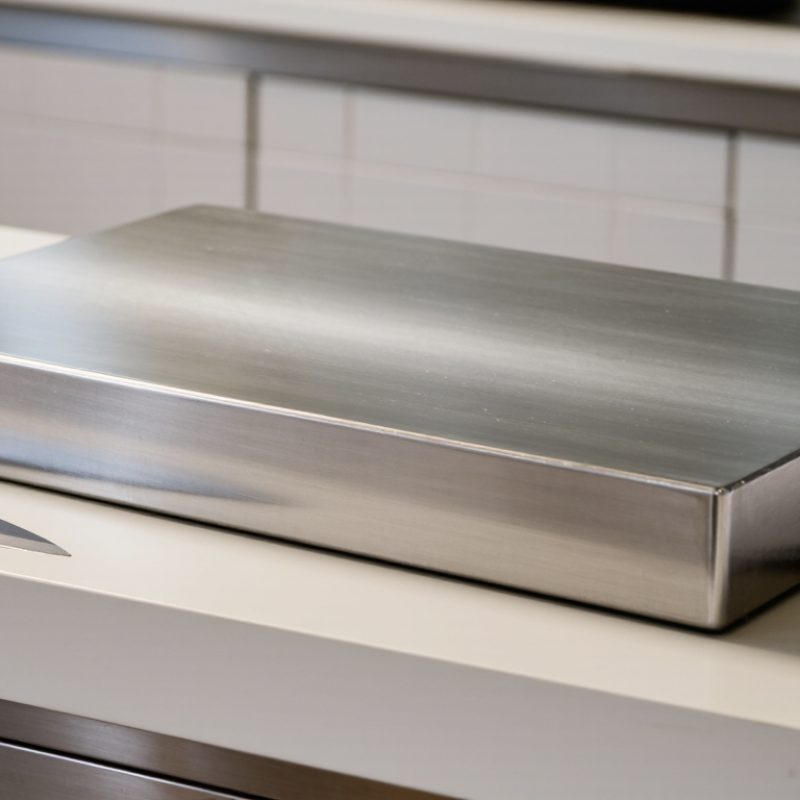
A steel cutting board is a food-preparation surface made with steel, usually stainless steel. The name alone does not reveal its full construction. Some boards use a single formed sheet; others bond a thin steel face to a rigid core. Edges may be folded or capped to cover sharp sheet edges and help keep the board stable. The underside can include feet or a non-slip layer. Small details matter.
Stainless steel is an alloy, not a single pure metal. Its chromium content helps it resist corrosion, while the board’s thickness and support affect how it feels under a knife. World Stainless reported 58.4 million tonnes of global stainless-steel production in 2023, showing the material’s broad industrial scale; that figure does not certify any individual board’s quality. A steel face can be smooth and easy to wipe, but it is hard on knife edges compared with softer cutting surfaces. There is a trade-off. Construction varies between products, and “steel” may describe only the top layer. Check the stated materials, edge finish, and whether the surface is securely joined to its core. A thin board may flex or sound sharp on a countertop. Not always obvious.
Type 304 stainless steel is a common food-contact grade. By weight, it typically contains 18–20% chromium and 8–10.5% nickel. Chromium helps form a thin protective surface layer when exposed to oxygen. That layer helps the steel resist rust and corrosion during ordinary kitchen use. Nickel supports the alloy’s structure and contributes to its corrosion resistance.
Those percentages describe the alloy, not every detail of a finished board. Surface condition, fabrication, and cleaning still matter. A smooth, intact surface is easier to wash after chopping juicy tomatoes or handling raw ingredients. Rinse away food, then wash with dish soap and dry the board; salt or acidic residue left sitting for long periods can still cause problems. Small scratches may appear with use. That is worth considering. Stainless steel is firm, and a knife can feel harsher against it than against wood or plastic. The exact feel varies with the board’s finish and the blade. Type 304 offers useful corrosion resistance, but its grade alone cannot tell you how comfortable a board will be to cut on.
A steel cutting board is usually a flat stainless-steel plate, but its surface finish affects cleaning and daily use. A brushed finish hides small scratches better, while a smoother polish is easier to wipe clean. The 3-A Sanitary Standards use a surface roughness limit of 0.8 micrometres Ra for many food-contact surfaces. That is a useful benchmark, not a guarantee that a board stays hygienic. Deep knife marks can still hold food residue. Shine alone proves little.
Thickness affects stiffness, weight, and sound. A thin sheet may flex on an uneven counter; a thicker plate feels steadier but is harder to lift and store. There is no perfect thickness for every kitchen. ASTM A480/A480M covers stainless sheet finishes and dimensional tolerances, giving fabricators a technical reference for specifying stock. Laser cutting makes precise outlines, while waterjet cutting limits heat exposure near the edge. Both methods leave edges that need careful deburring. Folded edges can reduce sharp corners, though they may complicate cleaning. Passivation under ASTM A967 can help remove free iron contamination after fabrication. Still, steel is loud under a knife, and that trade-off is easy to underestimate.
| Topic | Typical Options or Details | Practical Notes |
|---|---|---|
| What it is | A flat food-preparation surface made from stainless steel sheet or plate. | It is nonporous and easy to wash, but its hard surface can dull knife edges faster than wood or many plastic boards. |
| Common steel grades | 304: widely used for food-contact equipment because of its corrosion resistance. 316: offers improved resistance to chlorides and some corrosive environments. 430: magnetic and often less expensive, but generally less corrosion-resistant than 304 or 316. |
Grade selection depends on the food, cleaning chemicals, moisture exposure, and budget. The grade alone does not establish suitability for every application. |
| Surface finish | 2B: smooth, matte mill finish. Brushed: directional satin appearance. Polished: smoother, more reflective surface. |
Finish descriptions and roughness values vary by supplier and process. Fine surface texture can be easier to wipe than a heavily marked finish; scratches may appear with use. |
| Sheet thickness | Light-duty panels are often around 0.8–1.5 mm; more rigid panels may use approximately 2–3 mm or thicker material. | These are general fabrication ranges, not a universal standard. Required thickness depends on panel size, support, edge design, and expected loads. |
| Flatness and support | A thin sheet may be attached to a rigid backing or formed with stiffening features; a thicker plate may be used where added rigidity is needed. | Support helps reduce flexing, rocking, and noise. A board should sit securely on a stable, clean work surface. |
| Cutting and blank preparation | Common methods include guillotine shearing, laser cutting, and waterjet cutting. | The method is selected according to material thickness, shape complexity, production volume, and required edge quality. |
| Forming and joining | Edges may be bent or hemmed; assemblies may use welding or mechanical fastening. | Rounded or hemmed edges can make handling more comfortable. Welds and joints should be finished so they are smooth and easy to clean. |
| Edge finishing | Typical finishing includes deburring, edge rounding, polishing, and inspection for sharp corners or burrs. | A properly finished edge improves handling safety and helps prevent damage to cloths or cleaning tools. |
| Cleaning and care | Wash with warm water and a suitable detergent, rinse, and dry. Follow applicable food-safety procedures for the intended use. | Avoid prolonged contact with salt or chloride-containing cleaners, especially on grades with lower chloride resistance. Do not use a board with damaged or difficult-to-clean joints. |
| Best-fit applications | Useful where a durable, nonporous, washable surface is important, such as certain preparation, laboratory, or workshop settings. | For frequent knife work, wood or suitable food-grade plastic is often gentler on knife edges. Check local food-contact requirements for commercial use. |
A steel cutting board has a hard, nonporous surface that resists liquid absorption. That makes hygiene easier, but it does not make the board self-cleaning. Food particles, oils, and bacteria can still remain on its surface, especially around scratches or edges.
Clean the board after every use. Rinse away visible debris, then scrub it with hot water and dish soap. Pay attention to corners and the underside. Sanitizing without cleaning first is weak practice. After washing, apply a food-contact sanitizer according to its label instructions. Never mix cleaning chemicals. If the board is dishwasher-safe, use that setting, but check its care guidance first.
Dry the board completely with a clean towel or let it air-dry upright. Trapped moisture can create odors and may affect metal components over time. In a busy kitchen, separating raw meat preparation from ready-to-eat foods is also important. Wash your hands and clean nearby tools after handling raw ingredients.
A steel surface can be harsh on knife edges. Use controlled pressure rather than chopping aggressively. I used to focus only on visible stains, which was a mistake. A board can look clean while carrying invisible residue. Inspect it often for deep scratches, loose parts, or damaged seams, and replace it when thorough cleaning becomes difficult.
What Is a Steel Cutting Board?
A steel cutting board is a rigid food-preparation surface, usually made from stainless steel. It resists stains, odors, moisture, and deep scratches better than many softer boards. In practical kitchen use, it feels cool, solid, and extremely stable under a chef’s knife. It is loud.
That strength creates a clear performance trade-off. Steel does not cushion the blade, so each cut sends force directly into the knife edge. Repeated chopping can flatten or roll a fine edge faster than wood or quality plastic. The effect becomes more noticeable with thin, hard blades and heavy downward pressure. A sharp knife may still cut cleanly, but its crisp bite can disappear sooner. That trade-off matters.
Cleaning is simple: wipe the surface promptly, wash it with mild detergent, and dry it completely. Steel also avoids the deep grooves that can trap residue, although no surface is automatically hygienic without proper cleaning. I find it useful for messy ingredients, pastry work, and tasks involving strong odors. I would not choose it for delicate knife work or long chopping sessions. A rubberized underside can reduce sliding, but it cannot soften the cutting impact. My judgment is not perfect; cutting angle, force, and blade maintenance change the result. A steel board rewards durability and easy care, but it asks the knife to absorb more punishment.
Steel is highly durable but its hard surface can wear knife edges faster than wood or plastic. Ratings are approximate qualitative comparisons on a 1–5 scale, not standardized laboratory measurements; actual results vary by board and knife.
It is a rigid food-preparation surface, usually made from stainless steel. It feels cool, solid, and stable. It is loud.
Type 304 usually contains 18–20% chromium and 8–10.5% nickel. Chromium helps create a protective surface layer. Nickel supports structure and corrosion resistance. The grade helps, but it does not guarantee perfect performance.
Yes, when cleaned promptly. Rinse away tomato juice or raw ingredients, then wash with mild dish soap. Dry it completely. Salt and acidic residue should not sit on the surface.
It resists ordinary kitchen corrosion, but it is not invincible. Long exposure to salt or acidic food may cause problems. Scratches and poor cleaning can also reduce surface protection.
Yes. A brushed finish can hide small scratches. A smoother finish is easier to wipe clean. Deep knife marks may still hold food residue. Shine proves little.
A thin sheet may flex on an uneven counter. A thicker plate feels steadier but weighs more. It can also be harder to lift and store. There is no perfect thickness for every kitchen.
It may flatten or roll a fine edge faster than wood or quality plastic. Heavy chopping increases the effect. Thin, hard blades can show wear sooner. A sharp knife may lose its crisp bite.
It works well for messy ingredients, pastry work, and strong odors. It is less comfortable for delicate knife work or long chopping sessions. A rubberized underside may reduce sliding. It cannot soften the cutting impact. My judgment is not perfect; cutting angle and blade maintenance still matter.
A Steel Cutting Board is a food-preparation surface made from steel, typically formed as a flat, solid or reinforced panel. For food-contact use, Type 304 stainless steel is common; it contains 18–20% chromium and 8–10.5% nickel. The board’s surface finish, thickness, and fabrication method affect its feel, weight, stability, and ease of cleaning. Smooth finishes are simple to wipe down, while sturdy construction helps the board withstand regular use.
Steel offers durability and a nonporous surface, but it is much harder than wood or plastic and can cause knife edges to wear more quickly. To maintain good hygiene, wash and sanitize the board after each use, especially when switching between different foods, and dry it thoroughly. Choosing a suitable thickness and finish can make the board more practical, but users should weigh its long service life against the extra wear it may cause to knives.

Joywave