China Top 10 Hardwood Cutting Board Manufacturers

Time:2026-11-03 Author:Aria
0%

Choosing a supplier for Hardwood Cutting Boards involves more than comparing prices and product photos. A board may look smooth online, yet its edge grain, glue lines, and finish tell a fuller story. This guide introduces ten China-based manufacturers and the practical details buyers can check before requesting samples.

We consider hardwood selection, moisture control, construction methods, surface finishing, customization, and production capacity. Clear specifications matter. Ask which wood species are available, how boards are dried, and whether the finish is suitable for food-contact use. Request product documents and sample pieces where possible; marketing language alone is not proof. A close look at the grain, joints, and underside can reveal uneven sanding or small gaps. Details matter.

The companies featured may serve different needs, from compact retail orders to larger private-label programs. Their strengths should be assessed against your own requirements, not treated as a universal ranking. Confirm lead times, packaging, quality checks, and communication practices directly with each supplier. Conditions can change. Even a careful comparison has limits, since factory information and sample quality cannot guarantee every production run. That deserves reflection. Use this overview as a starting point for informed conversations, then verify current capabilities before placing an order.
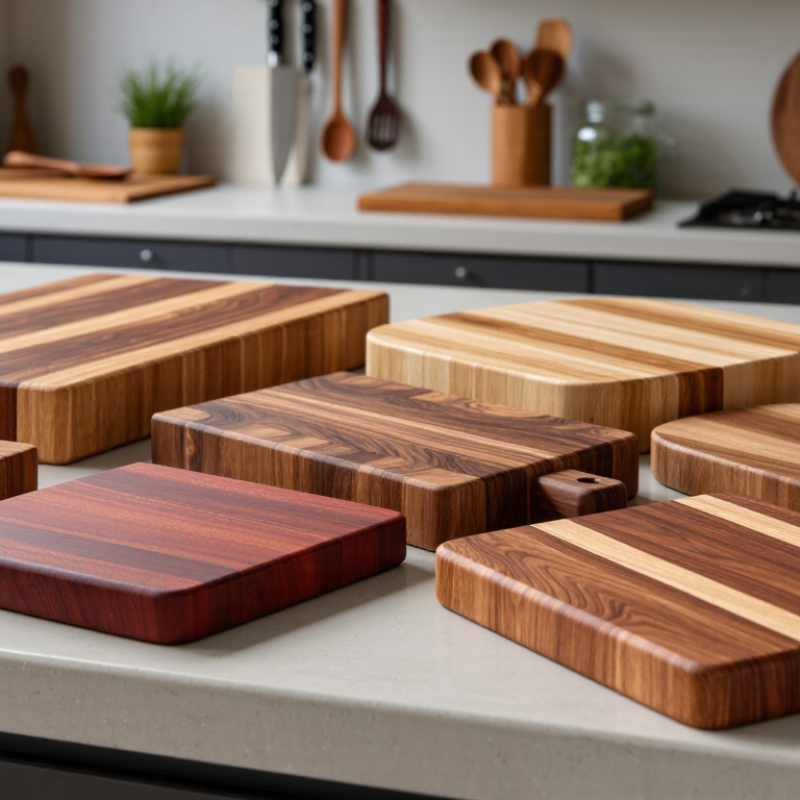
China Top 10 Hardwood Cutting Board Manufacturers

Understanding China’s Hardwood Cutting Board Manufacturing Industry

China’s hardwood cutting-board industry benefits from a deep woodworking supply chain, skilled machining, and access to varied timber inputs. The scale is substantial.

FAO’s Global Forest Products Facts and Figures 2022 reported worldwide wood-based panel production of about 401 million cubic metres in 2022, up 1.4% year on year. That figure covers many panel products, not cutting boards, so it signals industrial capacity rather than board output.

Production quality depends on details buyers can inspect: kiln-dried stock, even grain, smooth edges, and stable glued joints. Hardwood species differ in density and moisture movement; a dense board may resist knife marks but still warp if drying is uneven.

Small details matter. Ask suppliers how they measure moisture and inspect boards after machining.

UN Comtrade’s HS 4419 category groups wooden kitchenware, so its trade figures cannot isolate cutting boards or hardwood products. I would not treat broad export totals as proof of a factory’s consistency.

Sampling finished boards remains useful, though it cannot replace checking process controls and batch records.

Hardwood Types, Production Methods, and Quality Standards

Hardwood choice shapes a cutting board’s weight, appearance, and daily feel. Maple and beech are commonly selected for their fine, even grain. Walnut offers a darker tone, while acacia can show striking color variation. No species is perfect. Hardness, grain direction, and drying quality all affect how a board handles knife marks and moisture. For buyers comparing Chinese manufacturers, ask for the wood species and grade in writing, not just a product photo.

Production details matter just as much. Boards may use edge-grain or end-grain construction, and each has different appearance and wear characteristics. Careful kiln drying, stable glue joints, smooth sanding, and rounded edges help reduce cracking and splinters. Ask how moisture content is checked and whether finished boards are inspected for gaps, warping, and surface defects. A food-contact-safe finish should be clearly specified. “Premium quality” alone tells you little. Even a well-made board can move if it is stored damp or near heat.

Tips: Request a sample and inspect its edges, joints, and finish under good light. Ask for documented inspection criteria and consistent production measurements. Small details show. Still, one sample cannot guarantee every batch; that limitation is worth discussing before placing a large order.

Profiles of China’s Top 10 Hardwood Cutting Board Manufacturers

Profiles of China’s Top 10 Hardwood Cutting Board Manufacturers should compare production evidence, not just attractive product photos. Look for disclosed wood species, moisture-control procedures, grain construction, edge finishing, and batch inspection records. The USDA Forest Products Laboratory’s Wood Handbook reports American beech shrinkage of about 11.9% tangentially and 5.5% radially from green to oven-dry. That difference helps explain why drying and board construction matter: poorly controlled movement can lead to warping or splits. Details matter.

A useful profile also checks whether factories can trace timber by species and document incoming-material checks. FAO’s Yearbook of Forest Products reports global roundwood production of roughly 4.0 billion cubic metres in 2022. That figure describes a broad resource market, not the supply of board-grade hardwood in China, so it should not be treated as proof of any factory’s sourcing capacity. Ask for current production specifications, moisture targets, and inspection samples. A polished catalog is not proof. Comparisons can still be imperfect when suppliers disclose different levels of detail; that limitation should be stated rather than hidden. The strongest profiles distinguish verified factory information from sales claims and describe practical details, such as smooth corners, even thickness, and cleanly finished juice grooves.

China Top 10 Hardwood Cutting Board Manufacturers

Profiles of China’s Top 10 Hardwood Cutting Board Manufacturers

Janka hardness measures the force required to embed a steel ball halfway into wood. These representative reference values describe wood species, not individual manufacturers or their products; actual values can vary by species, grade, and sample.

Comparing Manufacturer Capabilities, Products, and Certifications

China’s hardwood cutting board manufacturers differ less by catalog size than by process control. Compare solid-wood and laminated options, edge-grain and end-grain construction, and details such as juice grooves, rounded corners, and stable feet. Ask how suppliers control timber moisture, glue application, sanding, and final inspection. A smooth surface matters, but so does consistent thickness across a production run.

The USDA Forest Products Laboratory’s Wood Handbook (2021) explains that wood begins to shrink and swell as moisture changes below its fiber saturation point, typically around 30 percent moisture content. This makes kiln-drying records and finished-board moisture checks useful comparison points. Request sample readings and ask how boards are conditioned before packing. A single reading is not enough. Honestly, many product pages omit this detail, so buyers may need to ask twice.

Certifications need careful interpretation. FSC or PEFC chain-of-custody documentation can support claims about certified material sourcing; it does not, by itself, verify food-contact suitability or workmanship. Request valid certificate scope, material traceability, and test documentation relevant to the intended market. Also compare audit records, production capacity, defect handling, and packaging protection. A cracked corner on arrival tells its own story. One imperfect area in supplier comparisons is relying on certificates alone; factory records and physical samples offer more useful evidence.

How to Evaluate and Source a Chinese Cutting Board Manufacturer

When evaluating a Chinese hardwood cutting board manufacturer, look beyond polished product photos. Ask which wood species are available and how each batch is identified. Request moisture-control records, board dimensions, and details about adhesives and surface finishes. These details matter. A board that looks smooth may still warp if the wood was not dried consistently.

Order samples before discussing large quantities. Check the edges, glue lines, grain direction, and finish under ordinary kitchen light. Ask the factory to produce a second sample using the same specifications. Compare the two. Small differences can reveal how well production is controlled. I would also ask how defects are recorded and what happens when a batch falls outside agreed tolerances. Not every supplier will answer clearly, and that is useful information.

Confirm minimum order quantities, lead times, packaging, and inspection steps in writing. If selling into a particular market, verify that materials and product documentation meet its applicable requirements. A factory visit or independent inspection can help, but neither replaces clear specifications. There is a trade-off: tighter tolerances may raise cost or limit wood selection. Be realistic. Start with a trial order, review the boards after transit, and revise the specification where needed. One overlooked detail can be the packaging. Boards need protection from moisture and impact during shipping.

China Top 10 Hardwood Cutting Board Manufacturers - How to Evaluate and Source a Chinese Cutting Board Manufacturer

A practical, brand-neutral scorecard for comparing suppliers. The benchmarks below are buyer-defined checks, not claims about any particular manufacturer.

No. Evaluation Dimension What to Check Evidence to Request Sourcing Guidance
1 Wood Species and Traceability Confirm the botanical or accepted trade name, country of origin, and whether the quoted species matches the sample and purchase specification. Species declaration, material specification, purchase records, and supporting origin documentation where available. Reject vague descriptions such as “hardwood” when a specific species is required.
2 Moisture and Wood Stability Agree on a moisture range suited to the product design and destination climate. As a starting point for discussion, buyers may specify approximately 8–12%, then validate suitability for the destination. Moisture-meter readings from multiple boards, measurement locations, date, and meter calibration or verification records. Set the acceptance range in the purchase order; do not treat a general range as universal.
3 Construction and Glue Lines Specify edge-grain, end-grain, or face-grain construction; check joint alignment, visible gaps, glue-line consistency, and resistance to ordinary use. Construction drawings, close-up sample photos, production sample, and documented inspection criteria. Approve a production-intent sample before confirming a bulk order.
4 Dimensions and Tolerances Define length, width, thickness, corner radius, flatness, and dimensional tolerances. These are buyer specifications rather than universal industry limits. Dimensioned drawing, inspection report, and measurements from a sample or pre-shipment inspection. Write tolerances and the measurement method into the approved specification.
5 Food-Contact Finish Identify the finish and its intended use. For food-contact compliance, determine the applicable requirements in the destination market; requirements depend on jurisdiction and product composition. Finish technical data, safety data where applicable, and relevant test reports tied to the exact finish and product configuration. Do not rely on “food-safe” wording alone; verify the claim against the destination market’s rules.
6 Workmanship and Defect Control Inspect for cracks, loose knots, splinters, rough edges, burn marks, delamination, excessive warping, and inconsistent sanding or finish. Written defect definitions, approved visual sample, inspection checklist, and records from a sample inspection. Agree on acceptable and rejectable defects before production begins.
7 Quality Management Check whether incoming wood, in-process work, finishing, and final packing have documented controls. ISO 9001 certification concerns a quality-management system; it is not product certification. Process flow, inspection records, corrective-action examples, and a current certificate if the supplier claims certification. Verify certificate scope and validity with the issuing certification body where relevant.
8 Capacity and Lead-Time Planning Request separate estimates for sampling, production, inspection, and shipping. Lead time and capacity vary by order size, design, season, and production schedule. Written production schedule, capacity statement, sample timeline, and milestone update plan. Use a trial order to check schedule reliability before scaling volume.
9 Packaging and Transport Protection Check protection against abrasion, impact, moisture exposure, and movement in transit; confirm carton dimensions, labeling, and packing configuration. Packaging specification, carton test or packing photos, carton markings, and a packed sample where practical. Confirm packaging requirements against the shipping route and retailer or importer standards.
10 Commercial Terms and Verification Compare quotation scope, minimum order quantity, tooling or sample charges, payment milestones, Incoterms® rule and named place, inspection rights, and defect remedies. Itemized quotation, signed specification, purchase order, sample approval record, and agreed inspection procedure. Resolve differences in scope and acceptance criteria in writing before paying a production deposit.

Note: This table is a sourcing checklist, not a ranking of named suppliers or a statement of any supplier’s actual performance. Confirm applicable product, food-contact, labeling, and import requirements for the destination market before placing an order.

FAQS

What should buyers inspect in a hardwood cutting board?

Check for even grain, smooth edges, tight joints, and a flat surface. Look closely.

Which wood species are commonly used?

Maple and beech often have fine, even grain. Walnut is darker, while acacia can show varied colors. No species is perfect.

Does a harder board always resist damage better?

Not necessarily. Density can affect knife marks, but uneven drying may still cause warping or cracks.

What should buyers ask about moisture control?

Ask how moisture is measured and whether records are kept. Request readings for finished boards, too.

How do edge-grain and end-grain boards differ?

They have different appearances and wear characteristics. Compare samples in person when possible; photos can hide details.

What quality checks matter after machining?

Ask whether boards are checked for gaps, warping, surface defects, and consistent thickness. One sample cannot prove every batch is consistent.

What does sourcing documentation confirm?

Chain-of-custody documents may support claims about material sourcing. They do not prove food-contact suitability or workmanship.

How can buyers assess a supplier beyond certificates?

Review inspection records, defect handling, production capacity, and packaging. A cracked corner on arrival is a warning. I would not rely on certificates alone.

Conclusion

This article explores China’s hardwood cutting board manufacturing industry, from the characteristics of common hardwoods to the production processes that shape a board’s durability, appearance, and everyday performance. It also explains how manufacturers may apply quality controls and relevant certifications, helping readers understand what to look for when assessing materials, workmanship, and consistency.

The guide profiles ten manufacturers without focusing on brand promotion, comparing their product ranges, production capabilities, and quality credentials. It concludes with practical considerations for evaluating and sourcing a Chinese supplier, including how to clarify specifications, review samples, assess production capacity, and communicate expectations. Whether sourcing for retail or food-service use, readers will gain a framework for comparing Hardwood Cutting Boards and making a more informed supplier decision.


Aria

Aria

Aria is a dedicated marketing professional with a deep passion for innovative strategies and a keen understanding of our company's product offerings. With a wealth of experience in the industry, Aria excels at crafting engaging content that highlights the unique features and benefits of our......