Choosing the right Marble Cutting Board supplier requires more than comparing prices on a product page. Global buyers must examine stone quality, production control, packaging strength, and communication reliability. This guide introduces China’s leading supplier landscape for professional kitchens, retailers, hospitality brands, and private-label businesses.
A dependable supplier should explain the marble source, board dimensions, thickness tolerance, surface treatment, and edge finishing. Buyers may request samples before placing larger orders. A sample can reveal uneven polishing, fragile corners, stains, or excessive weight. Small details matter. A board with smooth edges feels safer in daily use. Protective foam, reinforced cartons, and moisture-resistant wrapping can also reduce damage during long-distance shipping.
Supplier evaluation should include factory experience, inspection procedures, export records, and realistic production capacity. Ask for material documentation and product testing where relevant. Certifications may differ by market, so buyers should verify current requirements independently. No supplier is flawless. Even an experienced manufacturer may overlook packaging risks or respond slowly during busy seasons. That weakness deserves attention, not excuses. Clear drawings, signed specifications, and pre-shipment inspections can prevent costly misunderstandings.
The best Marble Cutting Board partner is not always the cheapest option. Consistent quality, transparent communication, stable lead times, and responsible after-sales support often create greater value. This overview helps global buyers compare Chinese suppliers with practical judgment. It also highlights questions that deserve deeper review before a long-term purchasing decision.
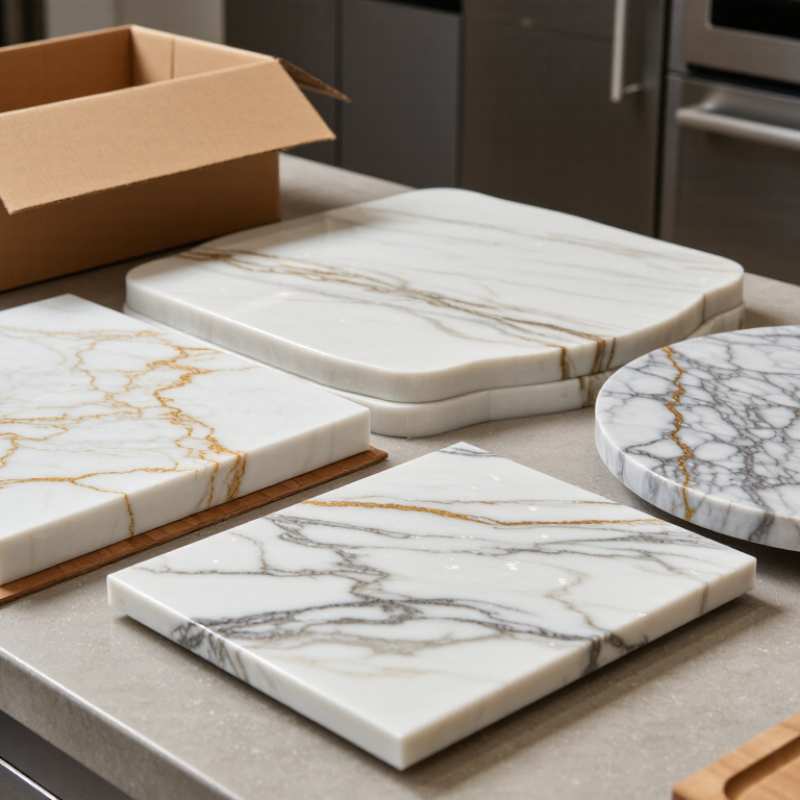
China Top Marble Cutting Board Suppliers for Global Buyers
Marble cutting board manufacturing in China combines stone processing, food-contact awareness, and export experience. Production often begins with blocks or slabs sourced from approved quarries. Workers inspect each piece for cracks, stains, and uneven density before cutting. Precision saws create consistent board dimensions. Edges are then polished, rounded, or shaped according to buyer specifications.
Surface finishing requires careful control. A board may receive honing, fine polishing, or a lightly textured treatment. Each option affects grip, appearance, and cleaning behavior. Experienced factories check thickness with calipers and inspect corners under bright lighting. They also review color variation because natural marble never looks completely identical. This detail matters for coordinated retail collections.
Food-contact documentation should be discussed early. Buyers commonly request material information, surface-cleaning guidance, packaging details, and relevant test records. Reliable suppliers can explain their inspection steps instead of offering vague promises. Protective foam, corner guards, and strong export cartons reduce damage during long-distance shipping. Still, no factory gets every batch perfect. Small shade differences can remain, even after strict inspection. That limitation deserves honest communication. Sample approval, production photos, and pre-shipment checks help reduce unpleasant surprises for global buyers.
China Top Marble Cutting Board Suppliers for Global Buyers
How to Evaluate China’s Marble Cutting Board Suppliers
Reliable supplier evaluation begins with the stone, not the catalogue image. Ask for the marble’s origin, hardness, water absorption, and test records. Natural stone varies, so confirm whether each batch matches the approved sample. Check dimensions with a caliper, inspect the polished surface, and examine every edge for chips or rough grinding. A cutting board should feel stable, clean, and comfortable to handle.
Request a physical sample before placing a large order. Test it on a level kitchen counter and inspect the surface after repeated washing. Ask how the supplier controls dust, stains, packaging damage, and moisture during production. Food-contact documentation may be necessary for your target market. Confirm factory capacity, inspection procedures, lead times, and carton strength. Factory photos help, but an independent inspection is more dependable. A perfect sample does not guarantee perfect mass production.
Tips: Ask for batch photos, written specifications, and a pre-shipment inspection. Compare sample weight with the stated weight. Clarify replacement terms for cracked or poorly finished pieces. Keep records of approvals and changes. No checklist is perfect; small details often expose larger quality problems.
China’s marble cutting board suppliers serve buyers seeking natural texture, weight, and premium presentation. Grand View Research estimated the global natural stone market at about USD 33 billion in 2023, with steady growth through 2030. That demand increases pressure on Chinese factories to control sourcing and finishing.
Material selection affects daily performance. Dense marble should show even veining, limited open pores, and a flat working surface. Granite offers greater scratch resistance, while marble provides a cooler surface and softer visual character. The 2024 IMARC marble market analysis reported continued demand from residential and hospitality applications. Yet, appearance alone is insufficient. Buyers should request quarry details, water absorption results, and testing for heavy metals and surface migration.
Design inspection needs practical detail. Check rounded corners, polished edges, stable feet, and a non-sliding underside. A 20-millimeter board may feel elegant, but its weight can increase shipping damage and handling costs. Suppliers should provide dimensional tolerances, packaging photographs, and batch records. ASTM dimensional-stone guidance can support size and surface evaluations, while destination-market food-contact rules still require separate verification. I have seen attractive samples fail because edges chipped during transit. Perfect photos can hide weak packaging. A small pilot order, independent inspection, and documented corrective action remain safer than trusting a catalog alone.
| Buyer Specification | Common Options or Reference | Practical Quality Check | Buyer Consideration |
|---|---|---|---|
| Material | Natural marble, a calcite-rich stone; color and veining vary by block and cut. | Confirm the stone type and approve a representative physical sample. Inspect for cracks, filled fissures, and inconsistent repairs. | Natural variation is expected. Specify acceptable variation and defect limits in the purchase agreement. |
| Material properties | Marble commonly has a Mohs hardness of about 3–4 and a density of roughly 2.6–2.8 g/cm³; actual values vary by stone. | Request quarry- or lot-specific technical information where properties are critical. | Marble can scratch or chip, and acids such as lemon juice or vinegar may etch its calcite surface. It is not equivalent to a knife-friendly wood or plastic cutting board. |
| Common colors and appearance | White, grey, beige, green, and black varieties; polished, honed, or other specified finishes. | Review samples under suitable lighting and check color, veining, finish, and edge consistency. | Photographs may not represent the full variation of natural stone. Approve a sample range for production. |
| Typical product dimensions | Buyer-defined formats, for example 300 × 200 mm, 400 × 300 mm, or 400 × 250 mm. | Measure length, width, thickness, flatness, and squareness against agreed tolerances. | These are example formats, not universal industry standards. State dimensions and tolerances in the order specification. |
| Thickness and weight | Commonly specified around 10–20 mm, depending on design and intended use. | Check thickness at multiple points and verify that the finished product is stable and free from visible cracks. | Stone is relatively heavy. Confirm packed weight, carton strength, and handling requirements before shipment. |
| Edge and surface design | Square, eased, rounded, or bevelled edges; polished or honed faces; optional grooves or handles. | Check edge smoothness, consistency, finish quality, and whether grooves or cut-outs have clean, intact corners. | Specify edge profile and finish with drawings or an approved sample. Avoid sharp edges that may chip easily. |
| Protective features | Optional non-slip feet, protective pads, or a fitted packaging insert. | Check that pads are securely attached and that any supplied components are described accurately. | Feet can improve stability but do not make a stone board impact-proof or suitable for every food-preparation task. |
| Food-contact and chemical requirements | Requirements depend on the destination market and the product’s intended use. | Request relevant material declarations and test documentation for the finished product and any coatings, adhesives, or attached parts. | Do not treat a general “food-safe” claim as a substitute for market-specific compliance evidence. Confirm applicable regulations with the importer. |
| Dimensional and visual inspection | Inspection plan agreed before production, including sampling level and defect classifications. | Record measurements and inspect for cracks, chips, stains, uneven polishing, sharp edges, and unacceptable repairs. | Set written acceptance criteria before mass production; natural veining should be assessed separately from workmanship defects. |
| Packaging and transit protection | Protective separators, cushioning, corner protection, and a suitably strong outer carton or crate. | Check packaging fit and review shipment condition after a documented transport or drop test appropriate to the distribution route. | Stone products are brittle and heavy. Packaging should prevent movement and protect corners during handling and transit. |
| Care and use information | Provide instructions for hand washing, prompt drying, and avoiding acidic cleaners or prolonged acid contact. | Check that care instructions match the actual stone and any applied treatment. | Marble is generally better suited to serving, pastry work, or presentation than repeated knife cutting; use a separate cutting surface to protect knives and stone. |
Global buyers need more than polished stone. They need predictable export service, documented safety, and clear customization. Grand View Research valued the global natural stone market at about USD 50 billion in 2023, with steady growth expected through 2030. This expansion increases pressure on suppliers to control quality across borders.
Experienced marble cutting board suppliers should provide samples, dimensional drawings, and production photographs before mass manufacturing. Custom options may include 10–30 mm thickness, juice grooves, rounded corners, engraved markings, and reinforced cartons. Each board should receive a surface inspection, size check, and packaging review. Food-contact declarations should reference applicable rules, such as the European Framework Regulation EC 1935/2004 and relevant United States FDA requirements. Compliance is not a slogan.
Traceability matters. A reliable export file can include quarry origin, material batch, inspection records, fumigation documents when required, and carton measurements. The International Trade Centre reports that natural stone products move through complex global supply chains, where classification and documentation affect customs clearance. HS-code confirmation should therefore happen before production, not after loading.
Small details cause real delays.
Suppliers should use moisture-resistant inner wrapping, corner protection, and drop-tested outer cartons. International buyers may also request third-party testing for heavy metals, microbial cleanliness, or chemical residues, depending on the destination. Not every supplier handles this perfectly. Buyers should question vague certificates, repeated size deviations, and missing corrective-action records. A dependable partner explains limitations early and keeps communication precise from quotation to delivery.
China’s marble cutting board suppliers vary widely in price, minimum orders, and reliability. Based on recent supplier quotations, standard boards often range from US$6 to US$18 per unit, while thicker, polished pieces may exceed US$25. Custom shapes, engraved logos, and gift packaging raise costs quickly. Small trial orders commonly begin at 50–100 pieces. Larger factories may request 300–1,000 pieces for custom production.
Market context matters. Grand View Research has valued the global natural stone market at more than US$30 billion, with steady growth expected through 2030. This wider data does not measure cutting boards directly, but it reflects sustained demand for stone products. Buyers should request quarry origin, material composition, edge-finish photos, and food-contact documentation. A low quotation means little if breakage reaches 5% during transport. I would compare landed cost, not factory price alone.
Reliability requires measurable checks. Ask for production samples, inspection records, carton-drop testing, and agreed replacement terms. ISO 2859-1 sampling can support a more consistent inspection process. Supplier response time also matters. Replies within one business day are useful, but not proof of factory capacity. Verify lead times against recent shipment records. My own caution is simple: marble is naturally variable, so perfect color matching is unrealistic. Good suppliers explain those limits before payment, not after complaints.
This indicative comparison uses common export quotation ranges for natural marble cutting boards. Lower prices and minimum order quantities may suit trial purchases, while higher reliability scores generally reflect more consistent quality control, packaging, and delivery performance. Prices are shown in USD per board, and reliability is rated on a 100-point scale.
Request physical samples, dimensional drawings, and production photos. Check thickness, grooves, rounded corners, and packaging details.
Boards may be 10–30 mm thick, with juice grooves, rounded edges, or engraved markings. Gift packaging can raise costs.
Ask for quarry origin, batch details, inspection records, and carton measurements. Confirm the HS code before production.
Standard boards may cost US$6–US$18 each. Thicker polished pieces can exceed US$25, while custom shapes add expense.
Trial orders often start at 50–100 pieces. Larger factories may require 300–1,000 custom units.
Use moisture-resistant wrapping, corner guards, and drop-tested cartons. A cracked corner can erase savings quickly.
Request documents that identify applicable destination requirements. Vague certificates deserve questions; documentation alone is not proof of quality.
Ask for size checks, surface inspections, and inspection records. ISO 2859-1 sampling may help, though natural stone still varies.
Compare landed cost, not factory price alone. Include freight, packaging, expected breakage, and agreed replacement terms.
Usually not. Marble varies naturally, so suppliers should explain color limits before payment. A perfect match may remain unlikely.
China has become an important manufacturing base for marble cutting boards, offering a wide selection of natural stone materials, engineered marble, shapes, finishes, and functional designs. Global buyers can evaluate suppliers by reviewing their production capabilities, material sourcing, inspection procedures, workmanship, packaging standards, and experience with international orders. Key quality considerations include surface smoothness, crack resistance, food-contact suitability, edge finishing, dimensional accuracy, and protective packaging.
Suppliers may also provide customization services such as private labeling, logo engraving, special sizes, color selection, gift packaging, and mixed product combinations. Buyers should confirm export documentation, product testing, packaging requirements, and compliance with destination-market regulations before placing an order. Comparing quotations requires more than checking unit prices; minimum order quantities, sampling fees, lead times, shipping terms, payment conditions, and after-sales support are equally important. A reliable Marble Cutting Board supplier should communicate clearly, maintain consistent quality, meet agreed schedules, and provide transparent service throughout the purchasing process.

Joywave